
Skip to content
New Concept Auto Service Honest · Accurate · New Concept
Mon–Fri · 7:30am–5:30pm 5 Johnson County Shops
№ 01
Brake Repair & Service

Brake Repair & Service

Expert Brake Repair & Service in Overland Park, South Overland Park, Merriam, Shawnee & Olathe, KS.

Book Service
ASE-Certified Technicians5-Yr / 50k-Mile WarrantyFree Brake Inspection QuoteAAA Approved
OverviewFig. 02

Your brakes are the one system you use on every single drive — and the one you can least afford to get wrong.

Brakes wear gradually, so the change is easy to miss until a stop feels longer than it should or a pedal starts to pulse underfoot. By the time most drivers notice, the pads are usually near the end of their life and the rotors are doing more work than they were designed for.

At New Concept, a brake visit starts with measuring what's actually left — pad thickness, rotor condition, fluid moisture, and the hydraulics that tie it all together — before anything is recommended. You get the real numbers and a straight answer on what needs attention now versus what can safely wait.

Symptom Explorer

What your brakes are trying to tell you

Braking problems announce themselves early if you know what to listen and feel for. Match what you're noticing to the signs below.

A note on symptoms — These signs point toward a likely cause — they are not a diagnosis. A professional inspection confirms what is actually happening before any parts are replaced.

Most pads have a built-in wear indicator — a small metal tab that deliberately squeals against the rotor when the friction material gets low. It's a design feature meant to get your attention before the pad is gone. A steady squeal usually means pads are due; it rarely goes away on its own.

Grinding typically means the friction material has worn through and metal is now contacting the rotor. This can score or gouge the rotor quickly, which often turns a routine pad replacement into a pad-and-rotor job. Grinding brakes should be inspected promptly.

A pulsation you can feel through the wheel or pedal — especially at highway speeds — often traces back to rotors that are no longer perfectly flat, or to uneven pad deposits. The fix depends on the measurement, which is why we check runout and thickness rather than guess.

A pedal that feels spongy or slowly sinks toward the floor can point to air or moisture in the brake fluid, a hydraulic leak, or a failing master cylinder. Because this affects how reliably the system can build pressure, it's worth a same-day look.

Pulling under braking can come from a sticking caliper, uneven pad wear, or a hydraulic imbalance between the two sides. It's both a stopping concern and a tire-wear concern, so it's worth diagnosing rather than living with.

Depending on the vehicle, this can indicate low fluid, a parking-brake issue, or — with the ABS light — a fault the system has stored. We read the actual codes and live data instead of assuming which one it is.

How It WorksComponent Explorer

Inside a modern brake system

01

Brake pads

The replaceable friction blocks that clamp against the rotor to create stopping force. They're engineered to wear out gradually so the harder, more expensive parts don't. Pad material and thickness are the first things we measure.

02

Rotors (discs)

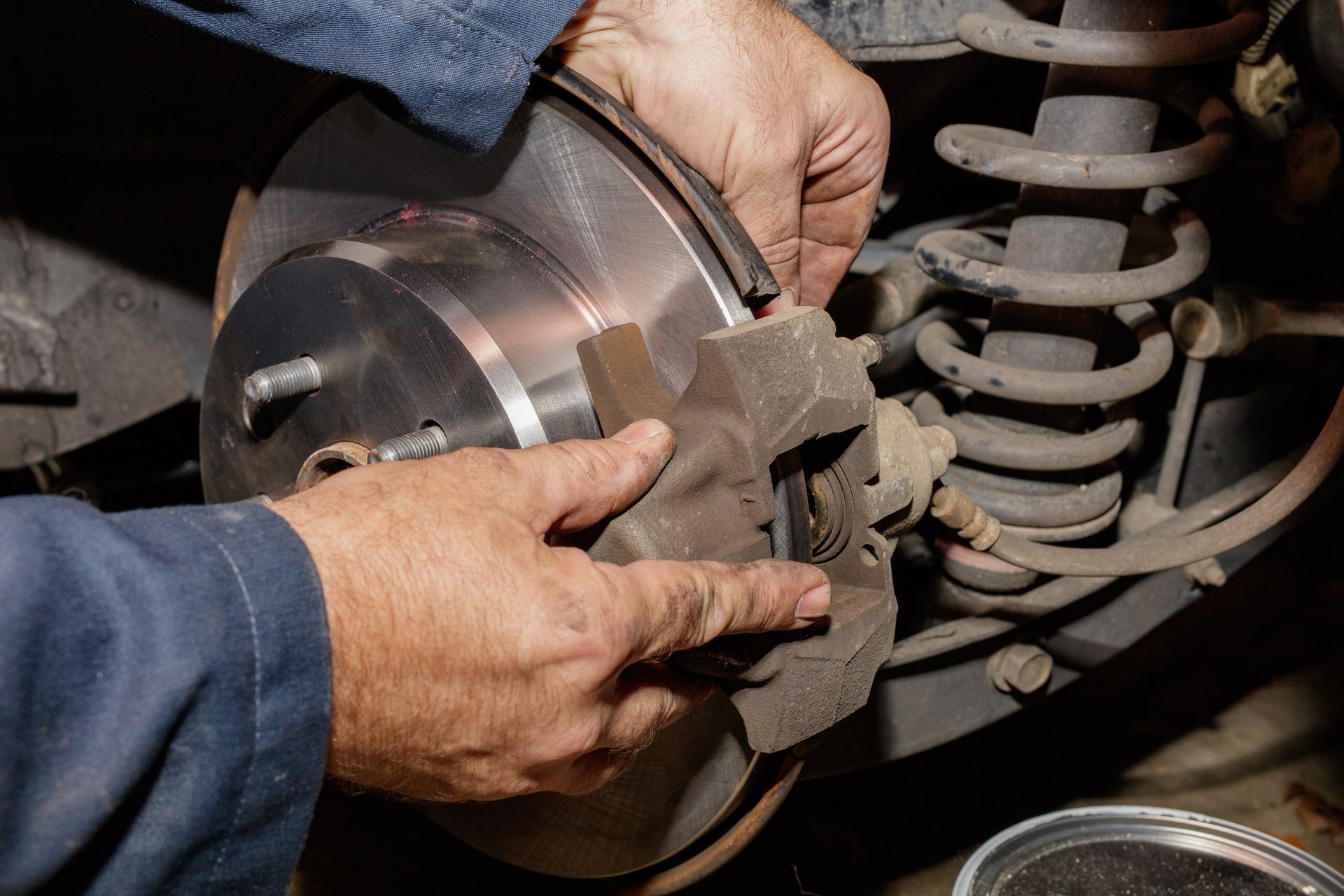
The large metal discs the pads squeeze. They absorb and shed enormous heat on every stop. Over time they can wear thin, warp from heat, or develop grooves — which is why we measure thickness and runout rather than replacing by mileage alone.

03

Calipers

The hydraulic clamps that press the pads into the rotor. A caliper that sticks or seizes causes uneven wear, pulling, or dragging — and can overheat a wheel. Calipers can often be rebuilt or replaced individually.

04

Brake fluid & hydraulics

Pressing the pedal moves fluid through lines to the calipers. Brake fluid absorbs moisture over time, which lowers its boiling point and can make the pedal feel soft. Flushing it on schedule protects the whole system.

05

ABS & wheel-speed sensors

The anti-lock braking system pulses the brakes to prevent wheel lockup, using a speed sensor at each wheel. When a sensor or module faults, the ABS light comes on and the system needs a scan to pinpoint the cause.

06

Parking brake

A separate mechanical or electronic system that holds the vehicle when parked. Cables stretch and electronic actuators can fault, so it's checked as part of a complete brake service.

What's Included№ 05 — Scope of Work

Brake repairs we handle

From a quick pad change to full hydraulic and ABS work, our brake services cover the complete system.

The Process

What to expect, start to finish

The same disciplined workflow on every job — so you always know what's happening and why.

  1. 01

    Initial inspection

    We start by listening to how the vehicle is behaving, then put it on the lift for a hands-on look at the system you came in for.

  2. 02

    Diagnostic testing

    Where a fault is electronic or intermittent, we scan control modules and test live data instead of guessing at parts.

  3. 03

    Findings & explanation

    You get a plain-language rundown of what we found — often with photos — so the problem is clear before any work is quoted.

  4. 04

    Repair recommendations

    We separate what needs attention now from what can safely wait, with an honest written estimate.

  5. 05

    Your authorization

    Nothing happens until you approve it. No surprise add-ons, no pressure.

  6. 06

    Professional repair

    ASE-certified technicians complete the work with quality parts, torqued and fitted to spec.

  7. 07

    Quality verification

    We re-test and road-check the repair, then hand the vehicle back backed by our nationwide warranty.

When To Come In№ 07

When to have your brakes checked

Watch for
  • Squealing, grinding, or clicking when you brake
  • A pedal that pulses, sinks, or feels soft
  • Longer stopping distances than you're used to
  • A burning smell after repeated stops
If you wait
  • Worn pads let metal contact the rotor, adding rotor cost
  • A sticking caliper can overheat and warp a rotor
  • Neglected fluid boils under hard use and fades the pedal
  • Compromised brakes mean longer stops when it matters
Stay ahead
  • Have pads measured at every tire rotation
  • Flush brake fluid on the interval in your owner's manual
  • Address noises early, while it's still just pads
  • Ask for a free quote before any shop starts work
Safety first
  • Never ignore a brake warning light
  • Pulsing or pulling affects control in an emergency stop
  • If the pedal goes to the floor, stop driving and call
  • A second opinion is always free here
Why Diagnostics Matter

Measured, not guessed

It's tempting to treat brakes as a simple wear item — just throw on pads and move on. But a squeal can be worn pads, glazed friction material, or a sticking caliper, and each one calls for a different fix. Replacing pads on a caliper that's hanging up just wears the new pads out early.

We measure pad thickness, rotor thickness and runout, and fluid condition, and we test the calipers and hydraulics. That's how a brake quote reflects what your vehicle actually needs — not a one-size-fits-all package.

  • 01Pad & rotor measured to spec, not estimated
  • 02Calipers checked for drag and even clamping
  • 03Fluid tested for moisture and boiling point
  • 04ABS faults read from live data, not assumed
QuestionsFAQ

Frequently asked questions

It comes down to measurement. If the pads are low but the rotors still have thickness left and run true, pads alone may be enough. If the rotors are below spec, warped, or deeply grooved, they're replaced or resurfaced at the same time. We show you the numbers so the recommendation makes sense.
A light squeal usually means the pads are getting low — it's a sign to schedule service soon, not necessarily to stop driving. Grinding is different: that often means metal-on-metal contact, which can damage rotors and reduce stopping power, so it should be looked at promptly.
There's no single number — pad life depends on how and where you drive, the vehicle, and the pad material. Stop-and-go city driving wears brakes faster than highway miles. That's why we measure pad thickness at each visit rather than quoting a fixed mileage.
A shimmy felt through the wheel while braking usually points to rotors that are no longer perfectly flat or to uneven pad deposits on the rotor surface. We measure rotor runout to confirm the cause before recommending resurfacing or replacement.
Yes. If another shop gave you a brake quote, we're glad to take a look and give you an honest written estimate for comparison, at no charge. Present the coupon from our Specials page at check-in.
Find A LocationFive Johnson County shops

Service near you

Book at the New Concept shop that's most convenient — same ASE-certified standards and nationwide warranty at every location.

01

Overland Park

9573 W 87th St, Overland Park, KS 66212
02

Merriam

6032 Merriam Dr, Merriam, KS 66203
03

Shawnee

4119 Bonner Industrial Dr, Shawnee, KS 66226
04

Olathe

128 N Mahaffie St, Olathe, KS 66061
05

South Overland Park

7601 W 119th St, Overland Park, KS 66213
Book an Appointment

Ready when you are.

Book online in under a minute, or call and talk to a real person. Honest estimates, no pressure — your dealership alternative in Johnson County.